

Intangible Heritage Exhibition Design for Qinhuai Library
Independent Commissioned Project
Project TypeDimensions:LocationVariable
Nanjing, China
Year2022
My RoleArt Direction, Visual Design, Pattern Design, Packaging Structure
Software and techniques used• Adobe Illustrator — pattern development, vector refinement
• Adobe Photoshop — texture adjustment, color optimization
• Adobe InDesign — layout, presentation, documentation
• Handcrafted Jian Zhi & Pi Ying cutting techniques
• Tang Dynasty motif research & visual pattern reconstruction
• Packaging structure design & paper engineering (300g specialty paper)
Project DescriptionThis project was commissioned by the Qinhuai District Library as part of a cultural heritage exhibition centered on traditional Chinese folk arts. The goal was to design visual patterns and packaging inspired by two historical craft forms — Jian Zhi (Chinese paper cutting) and Pi Ying (shadow puppetry). These arts have deep roots in Chinese history and storytelling, particularly during the Tang Dynasty, when decorative motifs flourished in murals, textiles, and architectural ornamentation.
Pattern and Packaging DesignTarget Audience
The primary audience includes visitors of the Qinhuai District Library and participants of cultural exhibitions focused on intangible heritage. This design also targets people interested in traditional Chinese crafts—especially Jian Zhi (paper cutting) and Pi Ying (shadow puppetry)—and cultural consumers who value artistic souvenirs, historical symbolism, and handcrafted work.
Design Problem
The main challenge of this project was developing a visual and packaging system that could respectfully represent traditional craft while translating it into a refined, contemporary format suitable for cultural exhibition.
We first needed to ensure that the Jian Zhi and Pi Ying pattern designs accurately reflected their cultural narratives, historical origins, and regional symbolism. At the same time, the visual system had to remain adaptable for hand-production, meaning the structural layout and motifs needed to be feasible for paper-cutting and shadow-puppet artists to fabricate by hand.
Beyond cultural accuracy and craft practicality, the packaging also needed to function as a protective and display-ready vessel—easy to store, secure for transportation, and visually elevated when opened for exhibition. The solution required maintaining balance between heritage, storytelling, and presentation, allowing traditional craftsmanship to live comfortably within a modern display context.
Design Process
To begin, I researched Jian Zhi and Pi Ying through festival traditions, historical materials, and visual archives. I focused on how paper cut art conveys narrative through silhouette, and how shadow puppetry brings figures to life through layered composition and movement. I then extended these observations into pattern development, drawing inspiration from Tang Dynasty mural motifs — floral symmetry, flowing geometry, and decorative repetition. Multiple pattern drafts were refined into final motifs that could be effectively translated into print, embossing, and display packaging. Based on the artwork themes, I designed foldable packaging structures using 300g specialty paper. The structure was engineered to store flat when closed and expand like a stage when opened — echoing the storytelling nature of shadow puppetry.
Patterns Inspired by Tang Dynasty Motifs Extended for Packaging Design
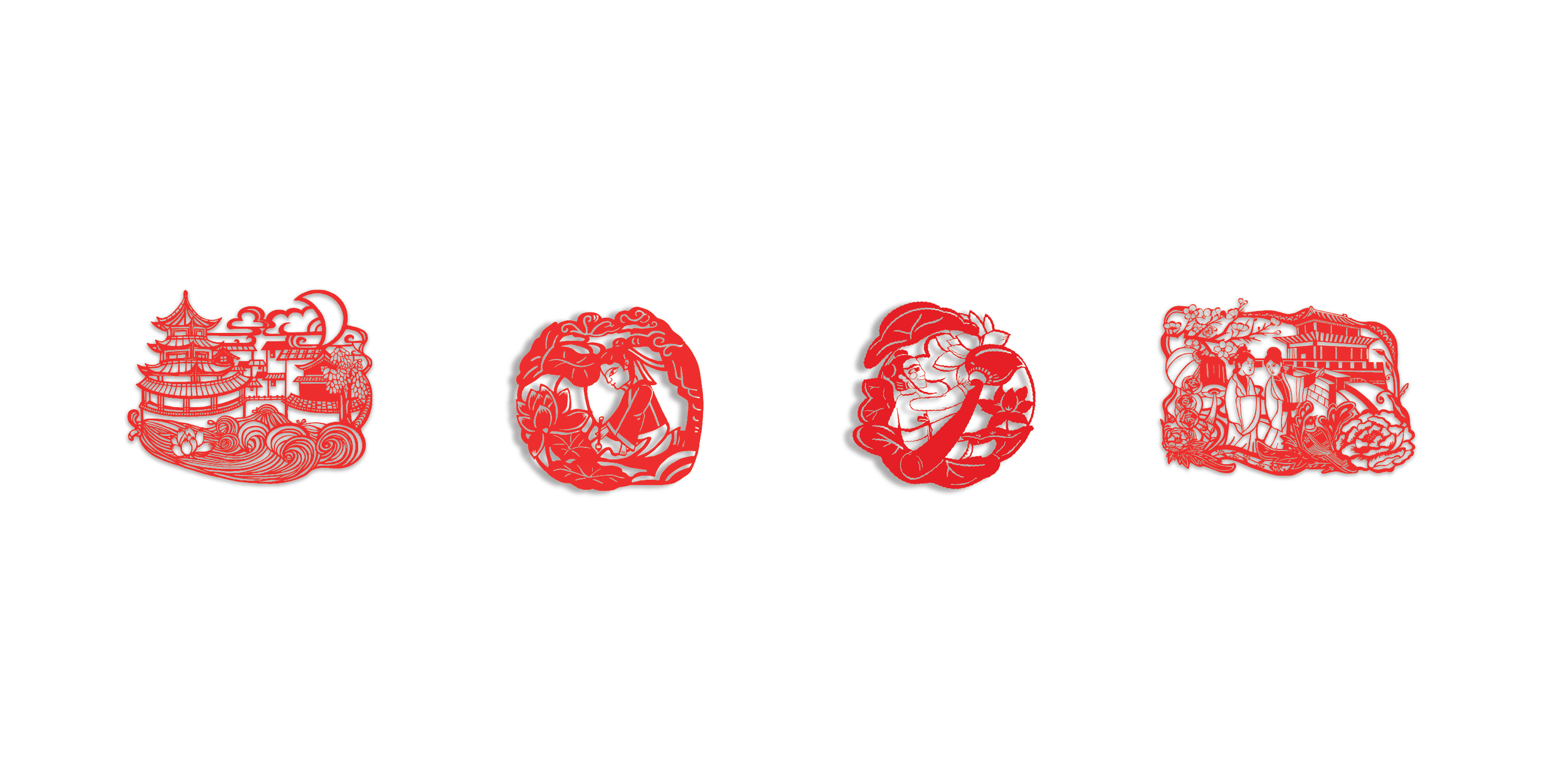
Zou Bai Bing is a significant tradition during Chinese festivals. Participants gather on the Lantern Festival night, walking along walls or into the outskirts, praying for blessings and health. The design draws inspiration from elements and features of the Lantern Festival and Nanjing’s Ming City Wall, a key local historical structure.
The Qinhuai River is the most famous historical and cultural symbol of Nanjing. It is the “lifeblood” of the city. The design is inspired by the iconic night scenery of the Qinhuai River, emphasizing the beauty of Jiangnan's water town with a blend of water elements and ancient architecture.
Wang Mian, a renowned Chinese painter from the Southern Song Dynasty, was known for his exquisite depictions of lotus flowers. Wang Mian's mastery in capturing the delicate details and vibrant beauty of lotus flowers has left a lasting impact on Chinese art. The pattern design is inspired by the traditional illustration layouts found in early Chinese textbooks. Combining the hollow structure of shadow puppetry with characters based on New Year painting figures, the design creates a shadow puppet representation of Wang Mian's lotus paintings.
Packaging Design
The packaging utilizes 300g specialty paper, composed of two parts adhered together, with internal creasing for precise folding.
The center features a fixed section for Jian Zhi / Pi Ying, allowing the product to be flatly stored when closed and unfolded into a stage-like display when opened.
The product requires plastic sealing.
Due to the workload of handcrafting the artifacts, the quantity for each pattern is 5 units.
Folding structure designed for both compact storage and secure display of the product.